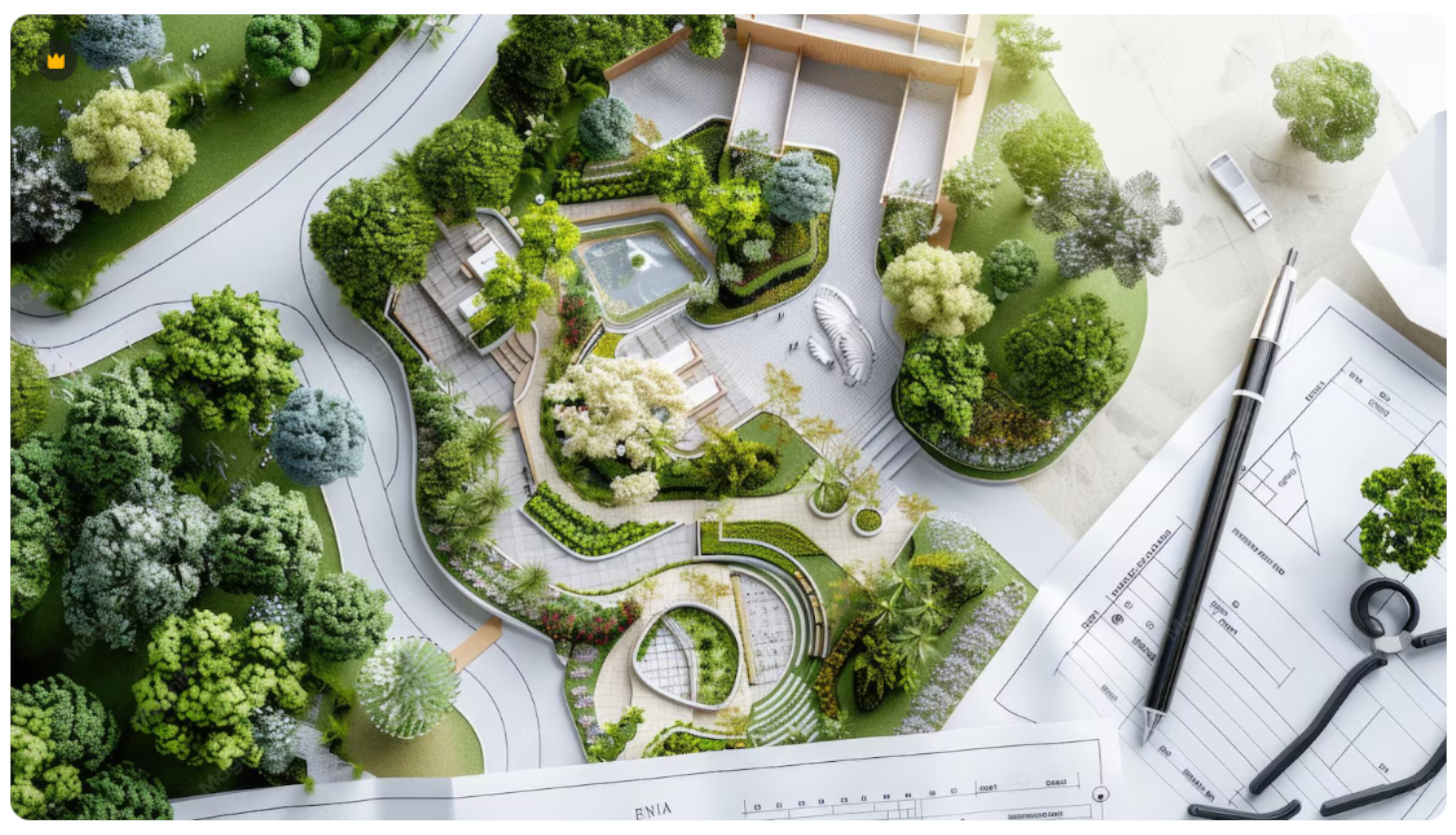
A Professional Digital Platform for Training Tomorrow's Landscapers
From first site visit to final invoice — the complete professional operating system designed for the landscaping businesses of tomorrow.
In our homes we turn on the news and we watch it unfold. Flooding. Fires. Drought. We grew up assuming — reasonably — that somewhere up the chain, the people in charge had a grip on it. They had been briefed by specialists for forty years: climate scientists, meteorologists, environmental advisors with decades of data. Naturally we thought: they know. It is under control. There is a plan.
Dunwich Heath (National Trust) and Minsmere RSPB — two of Suffolk's most valued nature reserves, home to rare heathland species that took decades to establish — have suffered serious wildfires in recent dry summers. Habitat gone in hours. Communities who had walked those heaths for generations watched them burn.
Meanwhile, the proposal to build Sizewell C — a major new nuclear plant — on the Suffolk Heritage Coast continues. On a coastline losing metres of land to the sea every year. On a coast where the medieval port of Dunwich already lies mostly underwater. One of the fastest-eroding shorelines in Europe. The concrete goes in regardless.
The summer of 2022 brought wildfires to the Gironde that burned over 26,000 hectares of pine forest around Bordeaux. More than 36,000 people evacuated from their homes. The largest evacuation operation in France since the Second World War — not a wartime emergency, but a climate one.
Less than five years later, in July 2026, fire returned to the same corner of France. This time it burned more than 42,000 hectares across Gironde and the neighbouring Landes, forced the evacuation of an estimated 260,000 people — nearly seven times the 2022 evacuation — and destroyed more than 240 buildings. The region grows vast monocultures of maritime pine for the timber industry: the same species, replanted close together across huge areas after the 2022 fires, that scientists now describe as a tinderbox. Rebuilding the landscape exactly as it was rebuilt the risk along with it.
That same summer (2022), the Loire, the Garonne, and rivers across France fell to historic lows. Parts of riverbeds that had never been exposed in living memory were suddenly visible. Fishermen, farmers, and mayors who had known these rivers their entire lives had no frame of reference for what they were seeing.
And we have all seen it. We are living through it.
We could hear all of this — the reserves, the rivers, the evacuations, the eroding coasts — and respond the way it is tempting to respond. "It has been a particularly difficult few years. An exception. Things will stabilise."
Maybe. But what if that is wrong? What if this is not a phase — but the new baseline? What if the window to do things differently is narrower than we think?
Stop. Think about it differently.
A chance has opened up — to build with nature, not against it. Because that stubborn instinct to restore everything exactly as it was — to replant what burned with the same monocultures, to rebuild what flooded in the same flood zones, to start from the same point and expect a different outcome — will not move us forwards. After the Gironde. After Minsmere. After every summer that ends with the same satellite images of smoke. The question is not just how fast can we restore what we had?
Is there another way? That is a big, open question. At Dreamscape, we think the honest answer to it begins in one place.
Education. The next generation of landscape professionals who will design the gardens, the green corridors, the urban plantings, the public spaces of the decades ahead. If they are trained from the right starting point — with climate not as a module footnote but as the premise of every design decision — then the spaces they create will cool, absorb, slow, and shelter. Not because they were told to be sustainable. Because they were taught to think that way before they ever drew a line.
That is the real reason behind this document. Everything that follows is the practical answer to that question.
I'm writing to you directly because I believe what we're building could find a natural place within your training programme.
I'd genuinely value your professional perspective on how to do that well.
Let me explain why this platform exists, what it does, and what we're concretely proposing.
Your student in three years — confident, professional, climate-ready.
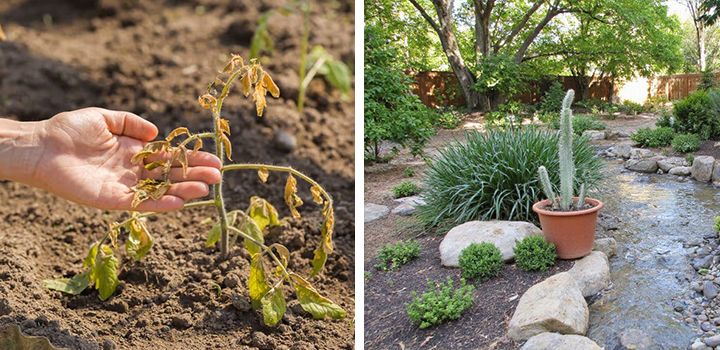
The landscaping sector is undergoing a profound transformation that your students will live through first-hand.
Climate change is rewriting the rules of garden design. The 2022 UK heatwave — the first time temperatures exceeded 40°C on British soil — was not an anomaly. Prolonged drought periods, unpredictable frost events, advancing invasive species, soils degraded by decades of inappropriate practices: all of this demands a fundamentally different approach to designing and managing outdoor spaces.
Flood events, hosepipe bans, and the collapse of traditionally reliable planting combinations are becoming the new normal.
The landscaper of tomorrow cannot simply plant what was planted before. They must design differently: heat-tolerant and drought-resistant species, intelligent water management, ecological corridors, permeable surfaces, green roofs, functional biodiversity. This is the 2.0 landscaper. And that professional needs tools that match that responsibility.
"Dreamscape Gardens was created for exactly this reason. Not to replace the knowledge and skill that comes from working the soil — that is irreplaceable — but to give landscaping businesses, and especially the youngest of them, the digital tools that allow them to work professionally, communicate their design decisions clearly to clients, and survive the first years of business without drowning in administration."
Why businesses fail at 18 months
Business failures in this sector are almost never caused by a lack of technical or botanical skill. The young landscaper who gives up at eighteen months knows their plants. They know how to work. They love their craft. What they lack is a series of professional behaviours — structured working habits that make a business function predictably rather than chaotically.
Responding to the client within 48 hours with a professional document rather than a voice message. Documenting every client exchange in a traceable location. Presenting a quote with a layout that inspires confidence. Scheduling the team by the week rather than day by day on WhatsApp. These are behaviours. Not botanical knowledge. Professional habits that are either acquired — or not.
Platform available in 6 languages
English · French · German · Spanish · Italian · Portuguese — a full i18n architecture built into the platform's foundations from the first lines of code, covering the entire interface. This is not automatic page translation. A student from abroad, a business working across European markets, or a professional managing projects in multiple countries uses exactly the same platform in their native language, without loss of functionality.
Dreamscape is not a collection of tools assembled to look complete. It is a system designed as a continuous workflow.
Each step feeds the next, with no re-entry, no lost information, no juggling between five different applications.
A client makes contact → they complete their brief online → the professional designs the garden → generates the PDF → sends the contract → the team is scheduled → timesheets fill automatically → the invoice is produced. From the first conversation to the last billable hour, everything lives in the same environment. That is the difference between a tool and a professional operating system.
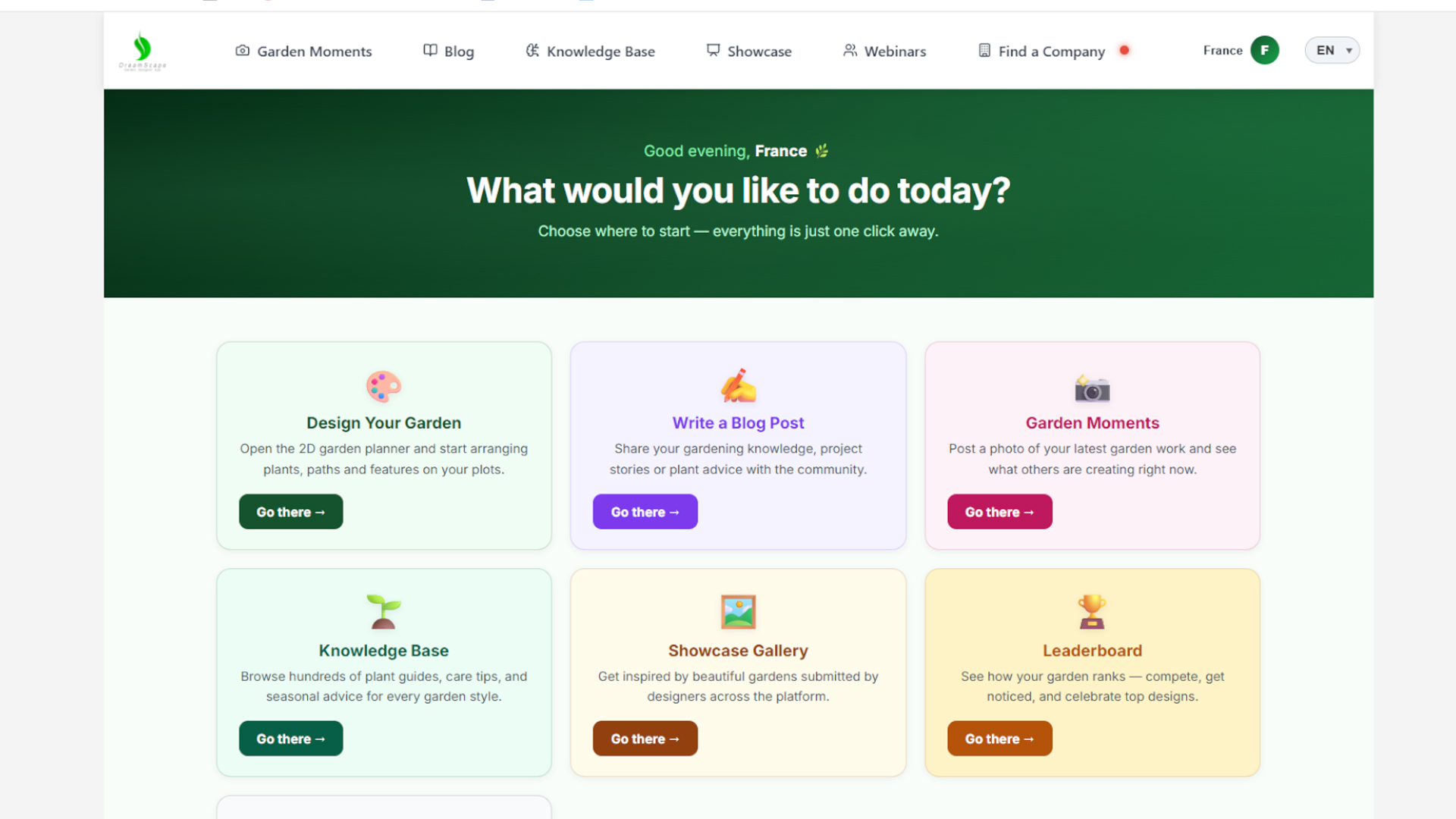
The Dreamscape user dashboard — the entry point for every member. Project overview, active designs, and quick access to all tools in one screen.

Live interactive workflow — use the scroll bar inside the window, or scroll with your mouse wheel to navigate all 17 steps.
Tools built exclusively for garden and landscape design — not adapted from architecture or civil engineering software.
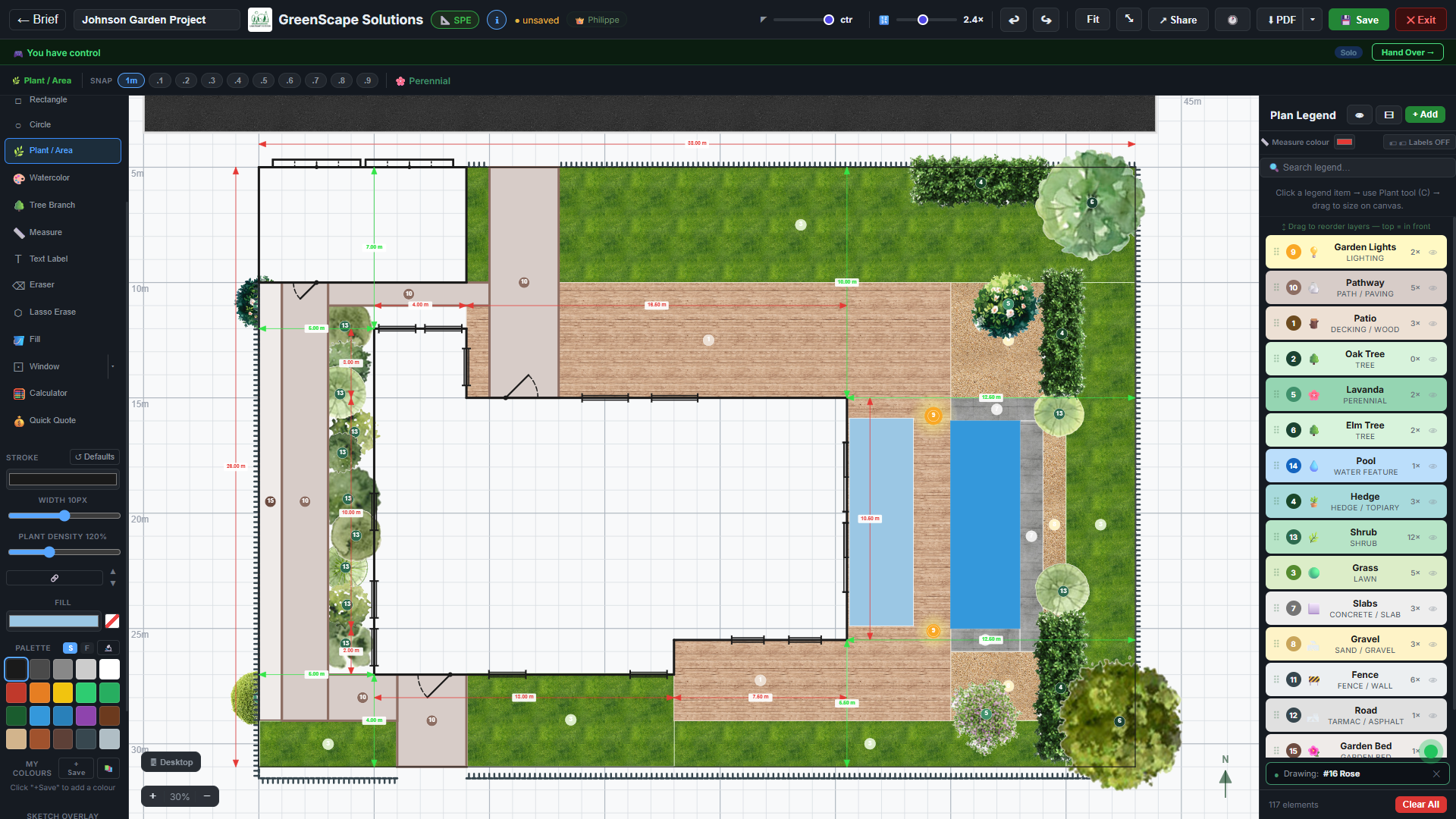
Step 1 of the professional workflow. Magnetic snapping for doors, windows, bay windows, garage doors — direction of opening set in one click.
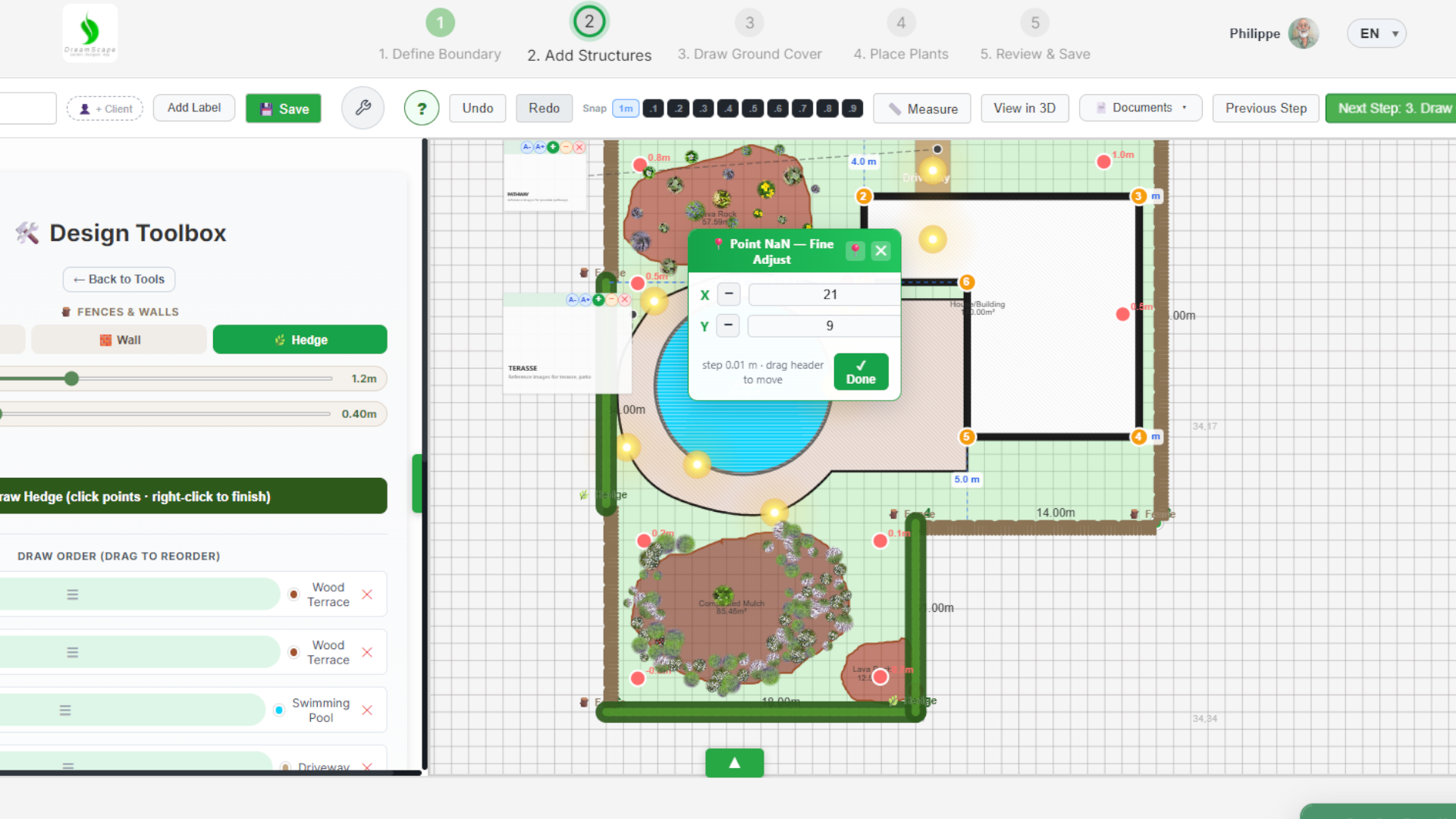
The 2D garden plan — plants, surfaces, structures, measurements, labels. Real-time 3D generates automatically in the background.
2D Garden Drawing with Real-Time Procedural 3D
The 3D engine is entirely procedural: the software automatically generates the 3D view from the 2D drawing data according to rules built into the engine — the professional draws in 2D and the 3D builds itself in the background, they never touch 3D modelling directly. What would take hours in SketchUp happens instantly, without extra effort.
Why are we able to do this? Because this platform was designed exclusively for garden and landscape design — nothing else. Part of the team that built Dreamscape has spent more than fifteen years in professional 3D. We know exactly what it costs in time, hardware and training to produce a quality photorealistic 3D render — and we also know that a landscaper at the initial presentation stage doesn't need one. What they need is a clear, readable and convincing view of their project, immediately available, without having to outsource to a 3D artist or master professional rendering software costing thousands of pounds a year.
Dreamscape was not built in a few weeks to chase a trend. It is the result of one full year of research into the real needs of landscaping businesses — small firms, sole traders, growing micro-businesses — followed by eighteen months of intensive development.
CAD Sketch Plan — Step 1 of the Professional Workflow
The professional begins by drawing the technical plan in Sketch Plan: dimensions, plant symbols, surfaces, walls, fences, pathways — and all the architectural elements of the existing building. The magnetic snapping system allows doors, windows, bay windows, sectional or sliding garage doors to be placed with immediate precision — the direction of opening (inward or outward, left or right) is set in one click and displayed correctly on the plan.
These details matter: the clearance of a garage door opening outward determines where a hedge can go; a north-facing window changes planting logic; a bay window recalibrates the entire 3D perspective. In most general-purpose software, this precision takes time. In Sketch Plan, it takes seconds.
This plan then imports directly as an overlay layer into the Garden Designer, with bidirectional synchronisation — changes in one are reflected in the other.
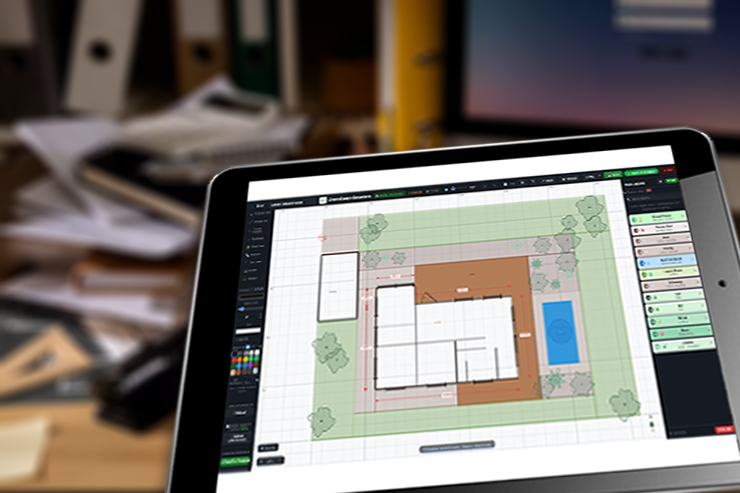
The Sketch Plan CAD on a tablet — used on-site and in the studio. No installation. No separate CAD licence.
A word on hand-drawn plans
Watercolours and sketches are beautiful, and for decades they represented the soul of the landscaper's craft. But delivering a hand-drawn watercolour of a client's garden takes several days — and in a context where climate urgency, market competition and client expectations have all accelerated, that delay has become a competitive disadvantage. We didn't abandon that spirit. We asked the AI to take it on: the platform can generate visual renders with a watercolour or sketch aesthetic directly from project data, to enrich client proposals without spending days producing them. The beauty remains. The time is reclaimed.
Plant and Species Catalogue
Each plant is added by drag-and-dropping a photo: the AI analyses the image and automatically fills in the record — botanical name, description, category, growing characteristics, mature dimensions. One photo, one complete entry. The price is entered by the professional themselves, deliberately: prices vary between suppliers, seasons and regions, and keeping a human in that loop ensures no AI error reaches a client quote. Once entered, every plant placed on the plan automatically updates the quote — no re-entry.
Before/After Visualiser
The design composited directly onto a real photo of the client's garden — the client sees their actual garden transformed, not a generic 3D render. This is the most powerful selling tool a young professional can have in a client meeting.
One-Click Complete Client PDF
2D plan, 3D view, illustrated plant palette with real photos, elevation profile, drainage analysis, itemised quote with totals and VAT, client brief summary. A document that most businesses take two to three years to learn to produce. Available from the very first project.
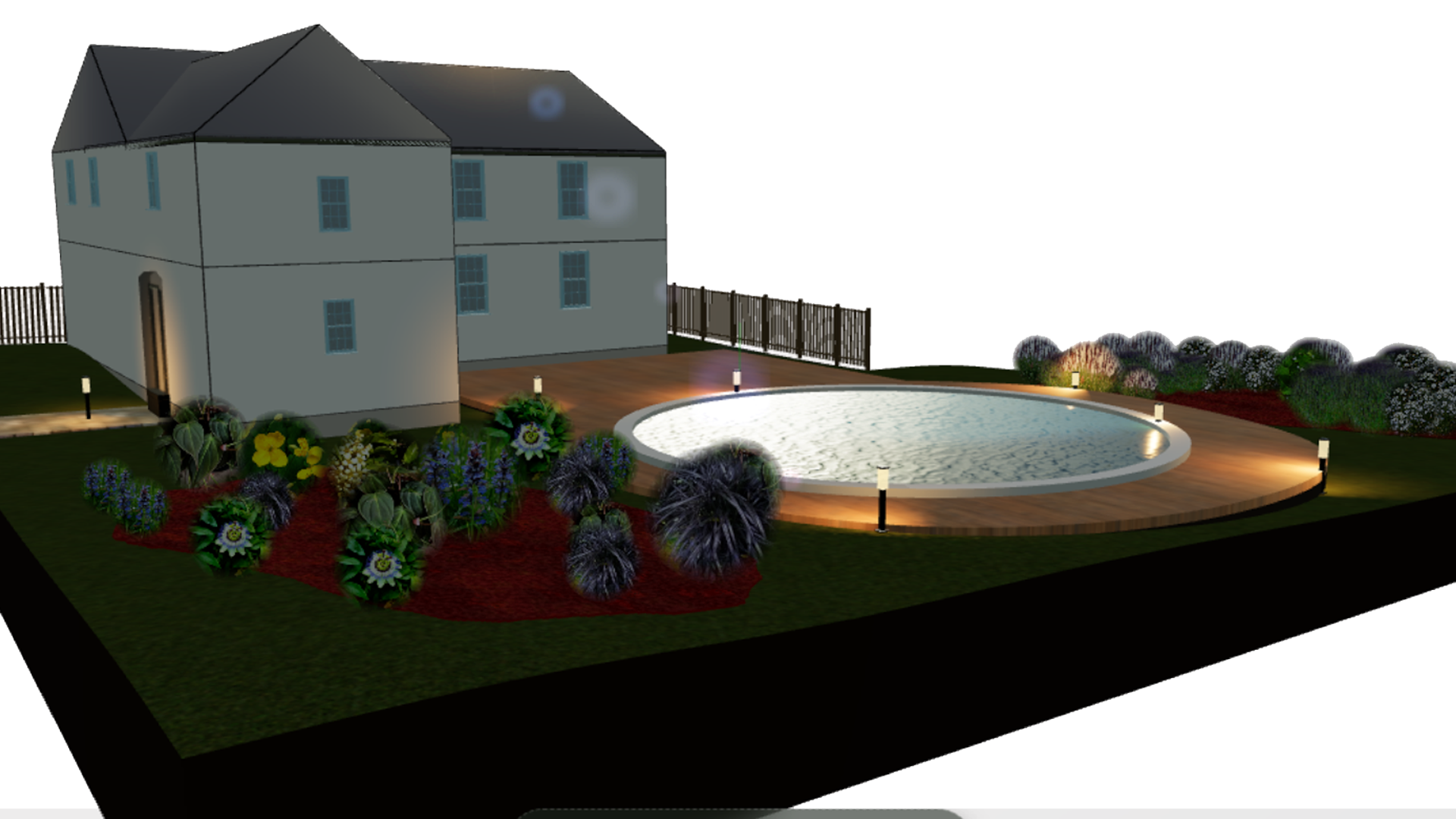
From Sketch Plan to this — automatically. No 3D modelling, no rendering software, no extra tools.
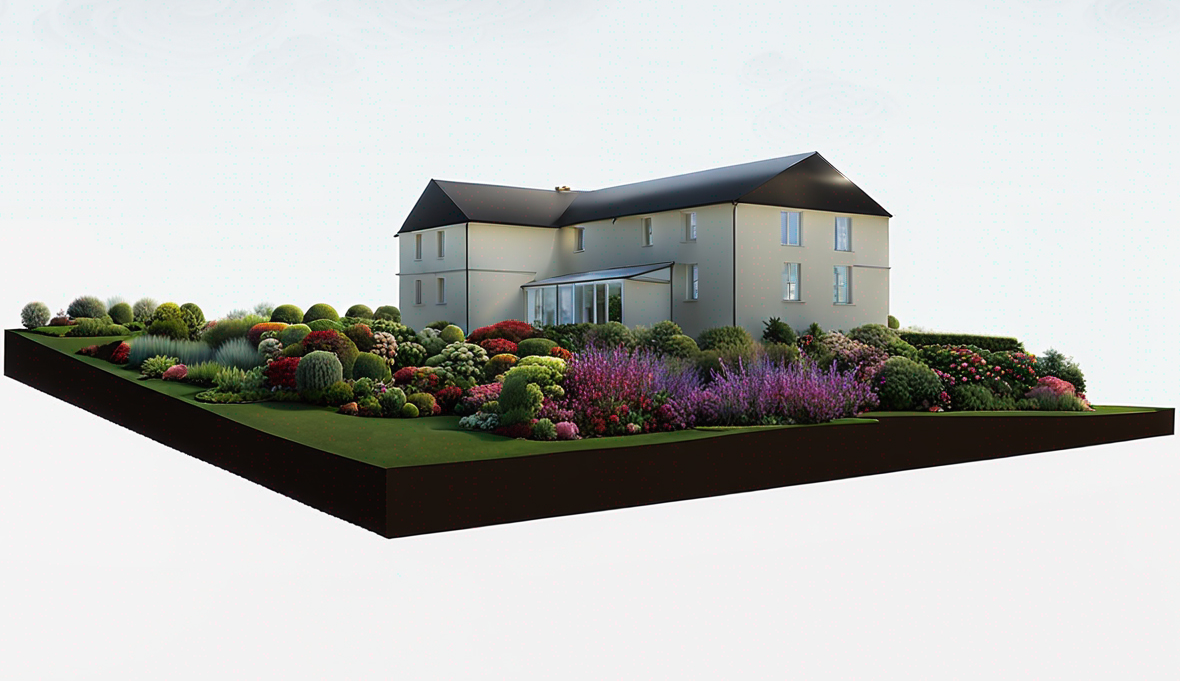
Garden, pool, evening lighting, fencing, planting — all generated procedurally from the 2D plan. The 3D updates live as you draw.
Why the Plants Look Stylised, Not Photorealistic
Maybe you're looking at that render and thinking: the house looks convincing — but those plants look a little odd, no? That's not an oversight. It's one of the earliest, most deliberate decisions we made building this platform.
Most garden design software gets you a good-looking 3D render by selling you plant model packs — a paid library of pre-modelled species, licensed separately, updated separately, and rarely a perfect match for what's actually available from your supplier or growing in a client's garden. We didn't want that dependency built into the platform.
So instead of licensed 3D models, every plant in Dreamscape starts as a real photograph. Take a photo of the plant, add it to the catalogue, and the platform processes that photo into the stylised form you see here and throughout the platform. It's a simple enough workflow that a business can photograph its entire current stock in an afternoon and have it all searchable in the database. A new plant arrives — same process: photograph it, drag it into the plant item form, and everything else — the 3D view, the plant lists, the client PDF — updates automatically from there.
The real payoff shows up later in the workflow, not just here: because every plant image traces back to an actual photo of an actual plant, the species on a client's plant list, PDF and quote is instantly recognisable — not a generic render that happens to look similar. One conscious design decision, made right at the start, that pays off in every document the platform produces afterwards.
Site-accurate design from the first visit. From a handful of laser readings, Dreamscape generates section views that most software requires weeks of learning to produce.
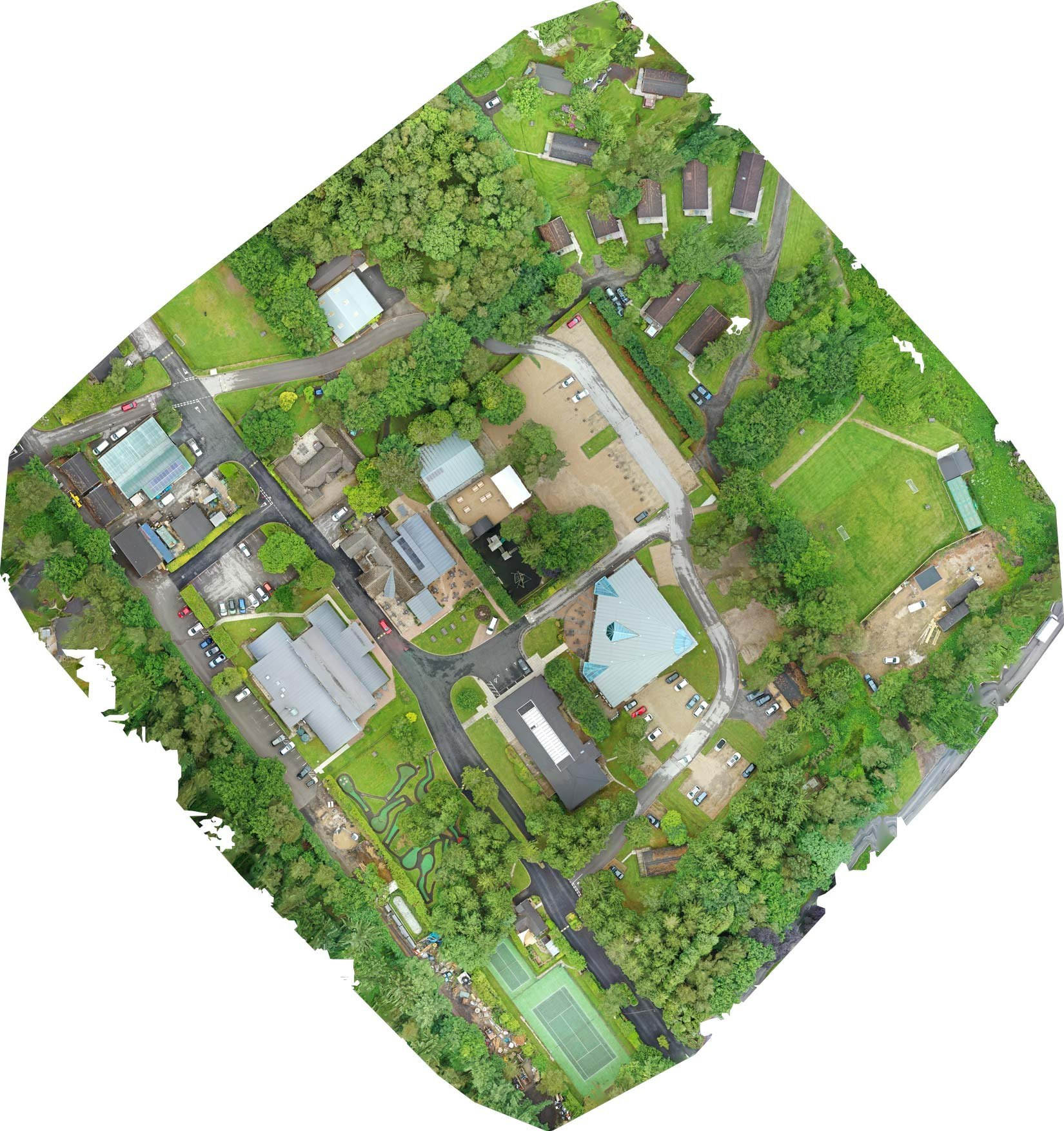
Real drone orthomosaic — geometrically corrected aerial view imported as a background layer directly into Dreamscape.
Drone Survey — One of the Very Few Times Dreamscape Calls Outside Its Own Environment
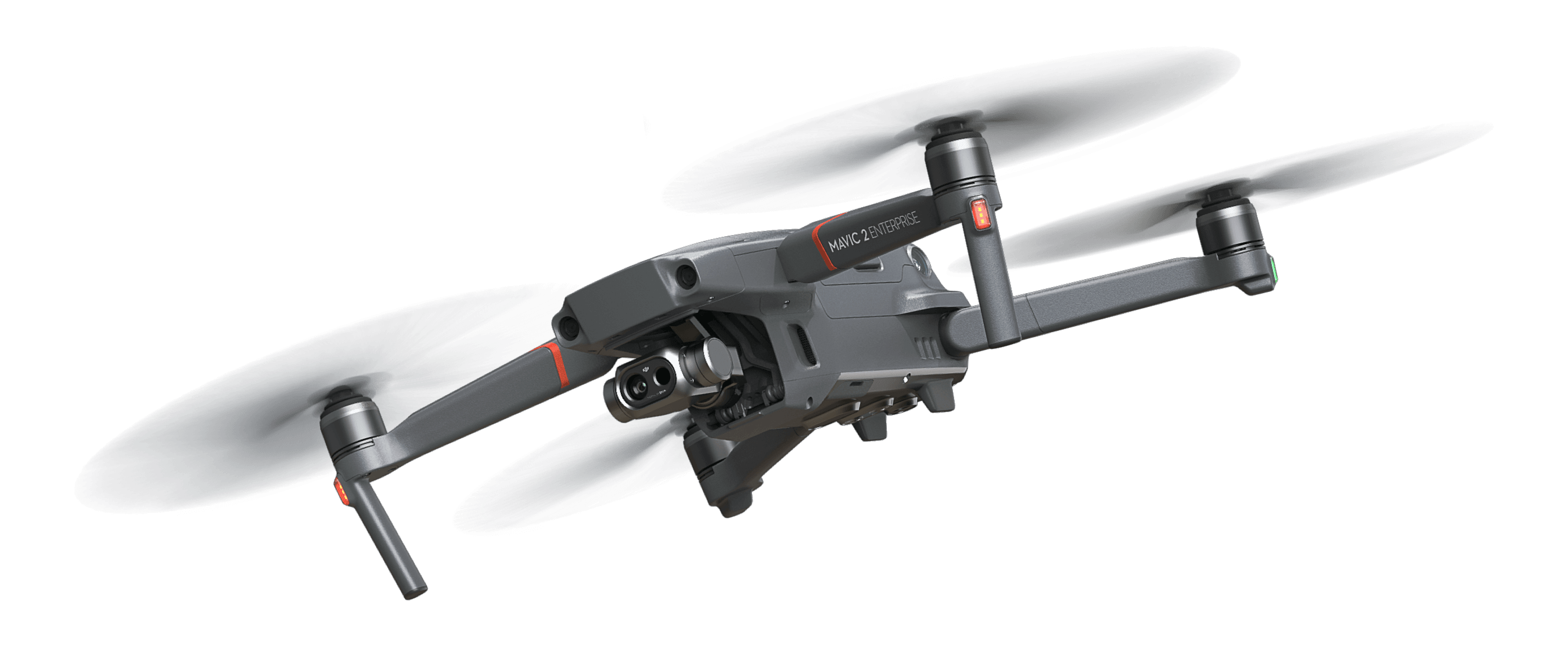
A consumer drone — a DJI Mini 3 costs under £350 in the UK, under €400 in France — puts professional-grade aerial capture within reach of any landscape designer. You fly the site yourself in under twenty minutes. The raw footage then passes through specialist processing software — DJI Terra, Pix4D, or similar — which stitches and geometrically corrects the images to produce the orthomosaic: a bird's-eye view with the positional accuracy of a professional land survey. This is the external step. Dreamscape does not process drone footage — that work belongs in tools built precisely for it.
That orthomosaic is then imported into Dreamscape as a background design layer, available in both the Sketch Plan CAD and the Garden Designer. The building footprint, boundary line, and every hard surface are traced directly on top of the real aerial image — not approximated from a site sketch. This is one of the very rare situations where Dreamscape reaches outside its own environment, and the reason is deliberate: specialist photogrammetry software already does this reliably. There was no reason to reinvent it. Everything that follows — layout, terrain analysis, drainage, planting, 3D visualisation, client documents — stays entirely inside the platform.
Site Elevation Survey and Terrain Calculation
On the first site visit, the professional records level readings from a fixed reference point to key points around the garden: base of slope, house threshold, projected terrace edge, back boundary. A laser level is sufficient — a standard tool available for under £80. These points are entered directly into the Designer.
The platform's mathematical engine automatically calculates the level differences between each zone — critical for two decisions: planting choices (some species cannot tolerate waterlogging) and hydraulic drainage slope calculations. The 3D engine integrates these elevation readings to anchor existing structures to the modelled terrain: the house, garage, retaining wall do not float in space — they rest on the topography calculated from your survey measurements.
From a handful of laser readings, Dreamscape generates lateral and frontal section views directly integrated into the client presentation.
What this replaced
Before Dreamscape, achieving this level of technical presentation required juggling a survey tool, a CAD package, a 3D engine, a rendering application and a presentation tool — months of searching, downloading, learning and stacked subscriptions. That is now in one place. Everything in one place: four words that genuinely change the life of a business that is just starting out.
Garden, pool, lighting, fencing — all generated automatically from the 2D plan. No 3D modelling required.
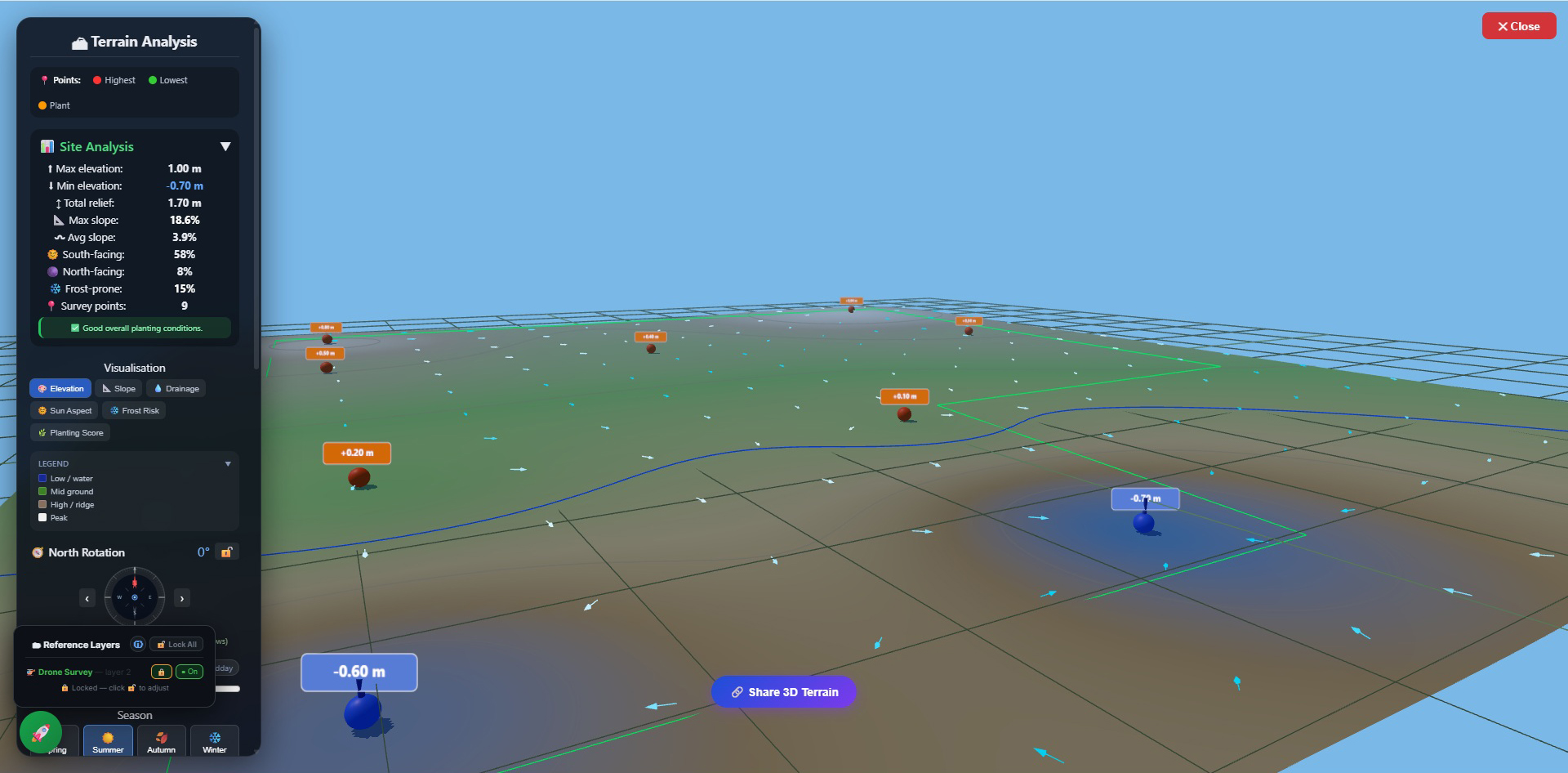
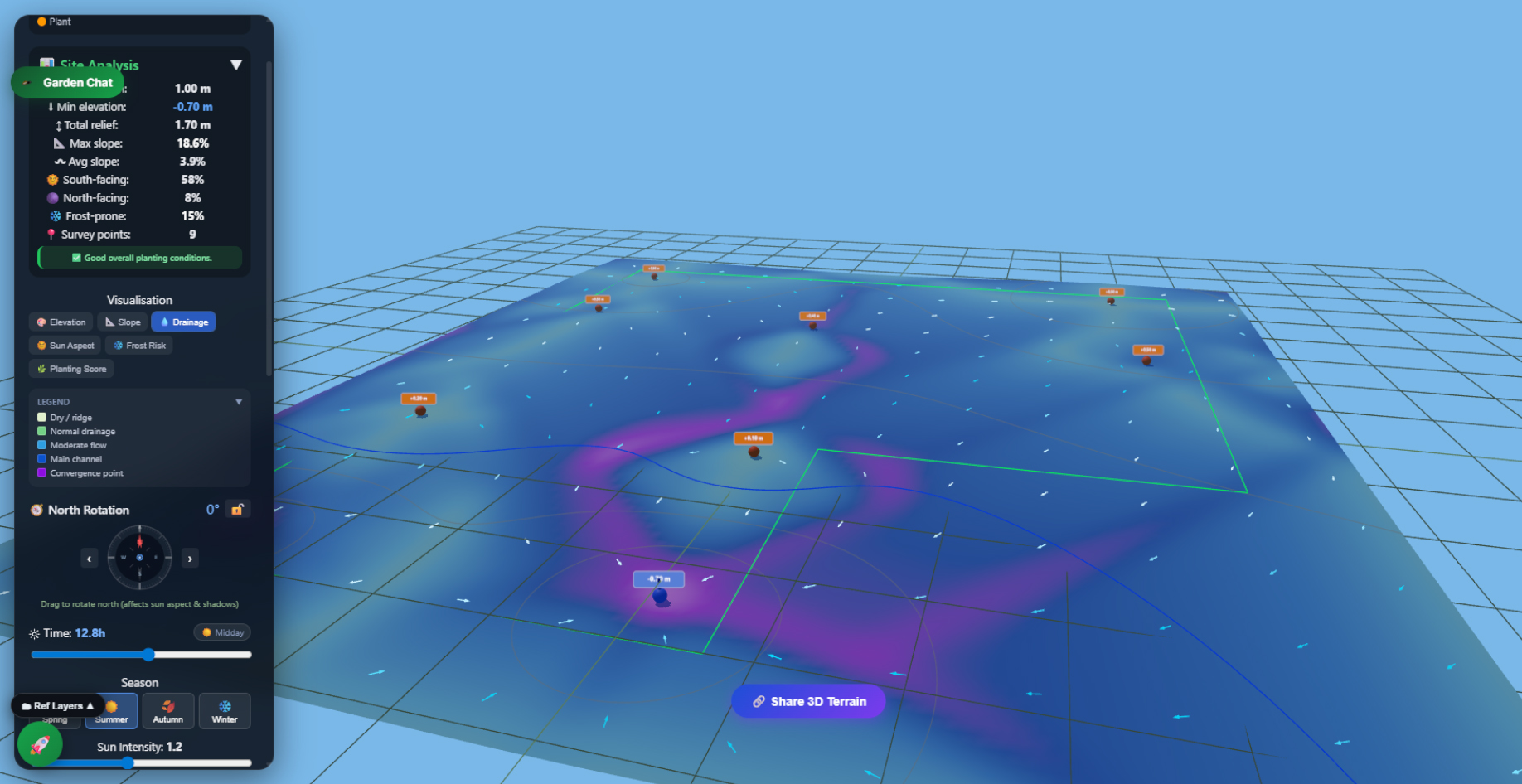
Max/min elevation, slope %, frost risk, sun aspect — calculated automatically from survey points. Planting Score shown.
Convergence points, main channels, waterlogging risk — critical for planting decisions and hard-landscaping layout.
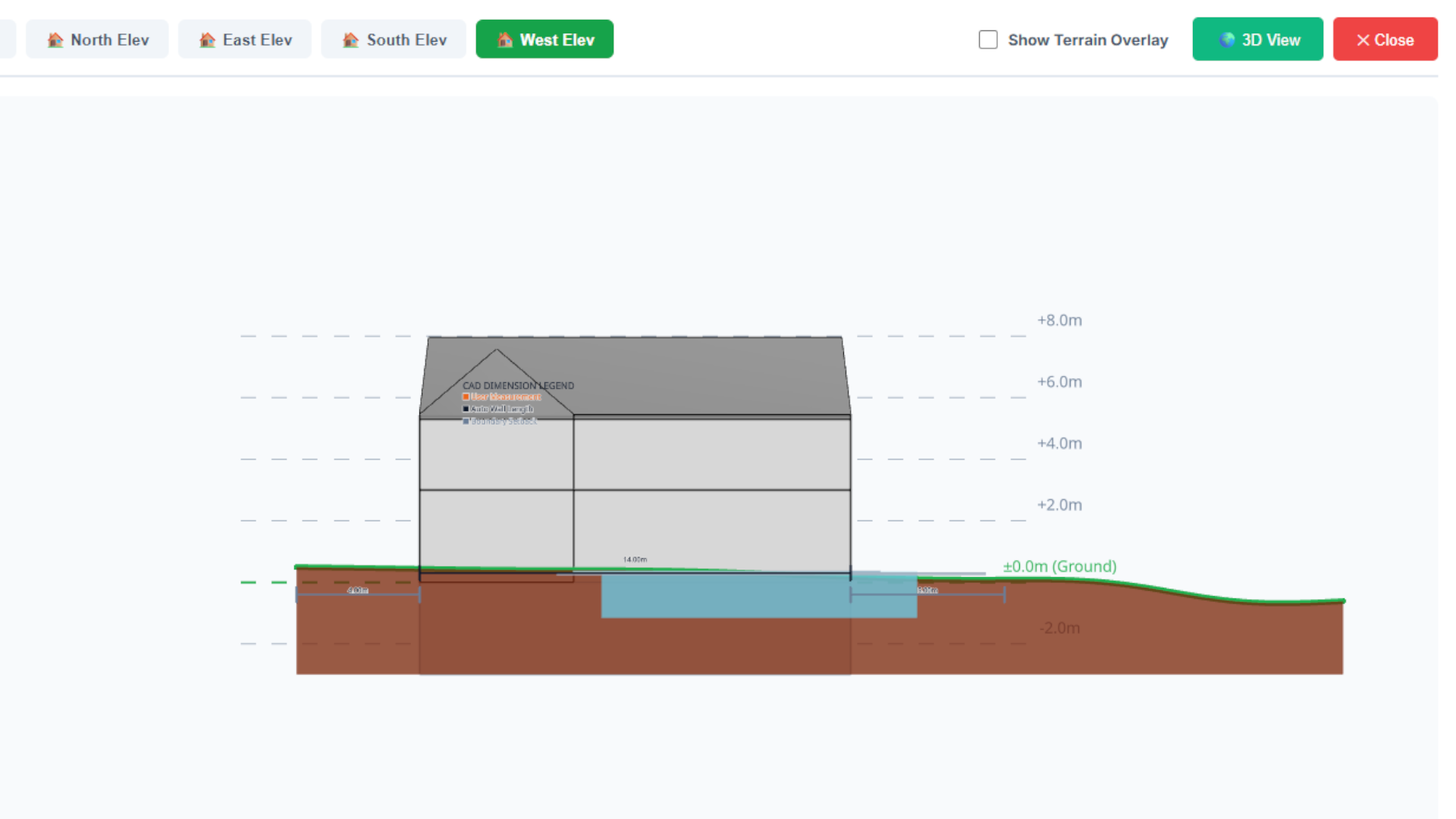
Auto-generated N/S/E/W elevations with terrain overlay. Available hours after the first site visit.
An important clarification on how we designed AI in Dreamscape — and why it matters for training.
Artificial intelligence is no longer a question of "do you need it?" — it is a question of "when are you going to integrate it, and how?" The last twelve months have seen unprecedented acceleration. AI is embedding itself into daily professional tools at a speed that no-one would have confidently predicted three years ago. Within three to five years, it will be present in the vast majority of professional software — not as an optional feature, but as core infrastructure. This is not a trend. It is the direction the working world is taking, across every sector.
The real question is not "does a gardener need AI to plant a tree or operate machinery?" Obviously not. The question is: why do the majority of young landscaping businesses fail within the first eighteen months? The answer, consistently, is administration, client communication, organisation — not a lack of technical skill. That is precisely where correctly integrated AI changes the outcome.
We made a deliberate choice: integrate AI at the heart of the Dreamscape workflow from the outset, not bolt it on afterwards. An AI assistant that lives inside your workflow, fed by the real data of your project, gets used. An AI tool you consult in a separate tab, a different application, gets forgotten and abandoned. The difference is not technological — it is behavioural.
"The AI in Dreamscape is not a generic chatbot grafted onto a garden application. Every AI assistant is driven by the real data of the current project. It does not generate creative content at random — it works from what the professional has already entered. The result is always grounded in the reality of the project, never invented. An unconstrained creative tool produces plausible but inaccurate content. An AI tool grounded in project data produces content that is directly usable."
The artificial intelligence in Dreamscape is an amplifier of existing skills, not a substitute for professional thinking. It removes administrative and editorial friction so that the landscaper spends their time where they have value: on-site and in the client relationship.
For your students specifically
If at any point your students are stuck on a feature or don't know where to start, the AI assistant is available directly in the interface to guide them — no need to search external documentation or send a support email.
Concretely, here is what AI does in Dreamscape:
Every step of the client relationship, structured and traceable from the first visit to the final invoice.
- Online client brief — During the first site visit, this structured form is the professional's site checklist: aspect, soil type, access constraints, existing vegetation, desired style, budget, timeline, children or pets. Everything in the right order so they never leave a site with missing information. After the visit, the professional invites the prospective client to join Dreamscape — a direct invitation from the platform.
- Shared project space — Once the client is registered, a shared project space activates: the garden design in progress becomes visible to both parties. The client can follow the progression, see plant and surface choices, and track the project from their own space.
- Integrated project chat — Direct, traceable communication between both parties around the project: questions, adjustments, design approvals — all archived within the project context, never scattered across personal WhatsApp threads. Brief data integrates automatically into the contract and the PDF. No re-entry, no lost information from the first visit to final delivery.
- Digital contracts — Legally binding under UK law (Electronic Communications Act 2000 and UK eIDAS Regulation). All project costs import automatically from the quote. The professional signs first, the client receives a secure link and signs from their phone. Timestamped, archived, legally evidenced.
- Integrated client CRM with full project history — Every client, every exchange, every completed project, permanently accessible. The company's memory no longer depends on the owner's memory.
- Billing and cost management — Linked directly to project elements, no re-entry.
Team Management and Organisation
- Team Hub — Visual overview of all active projects: who is working on what, at what stage, with what priority. An overview that replaces Monday morning meetings and Friday evening WhatsApp calls.
- Weekly schedule with automatic monthly timesheet completion — Planned hours automatically become declared hours. What used to take half a day of admin per month happens without intervention.
- Active time tracking by project — Time actually spent on each project is tracked, allowing future quotes to be refined from real data rather than estimates.
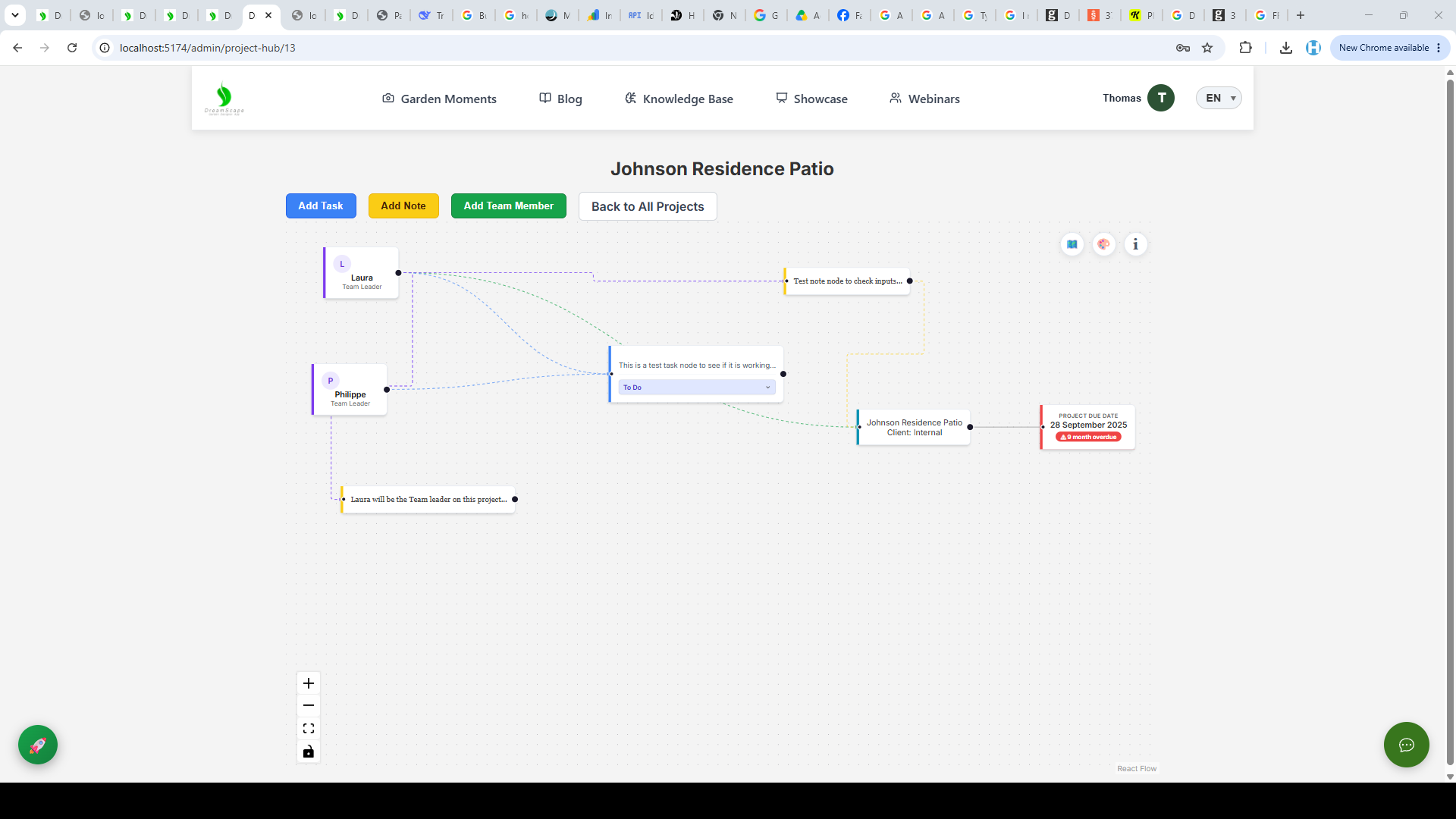
Team Hub — project structure, task assignments, deadlines and milestones at a glance.
Business Chat — the feature talked about least and the one that solves the most costly problem in the sector.
In the vast majority of small British landscaping businesses, team communication happens on personal WhatsApp. On the surface, it works. In reality, it is a silent disaster:
- ✕Project information gets lost in conversation threads mixed with personal messages
- ✕When a team member leaves, their entire professional communication history leaves with them on their personal phone
- ✕There is no traceability, no archive, no evidence in the event of a client dispute
- ✕Site photos, decisions made, client-requested changes — all scattered across private devices
- ✕The owner has no visibility over what was said, by whom, at what moment
Business Chat keeps all professional communications inside the Dreamscape environment: team exchanges, site photo sharing, documented decisions, searchable history. When an employee leaves, the business retains everything. When a client disputes, the evidence exists.
This is not a feature. It is the line between professional and amateur — and for a young business owner learning to manage a team for the first time, understanding the importance of that line from the outset can prevent very difficult situations.
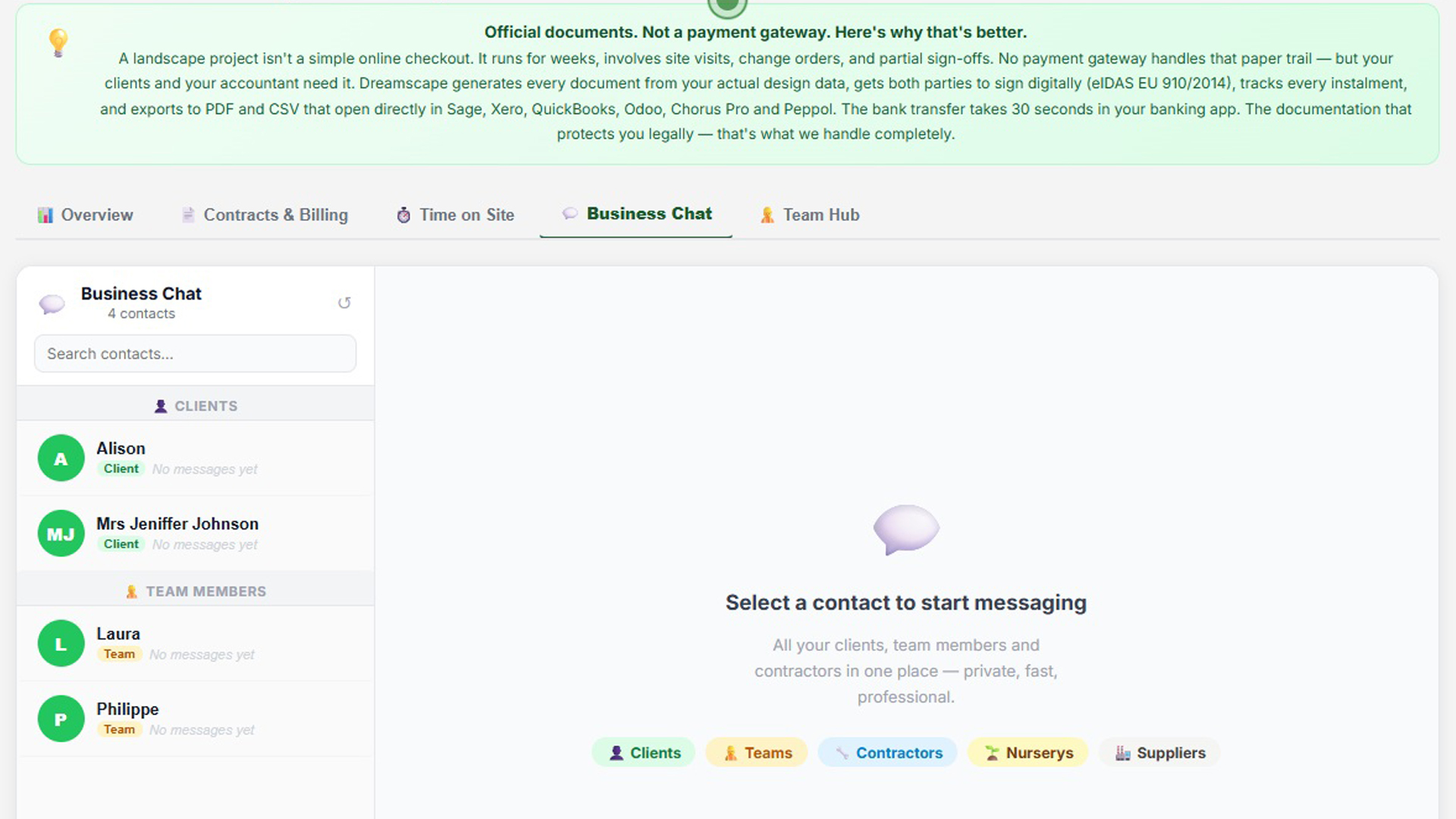
Business Chat — clients, team members, contractors and suppliers all in one structured, searchable environment.
The blog integrated into Dreamscape is one of the modules that most surprises people when they first discover the platform.
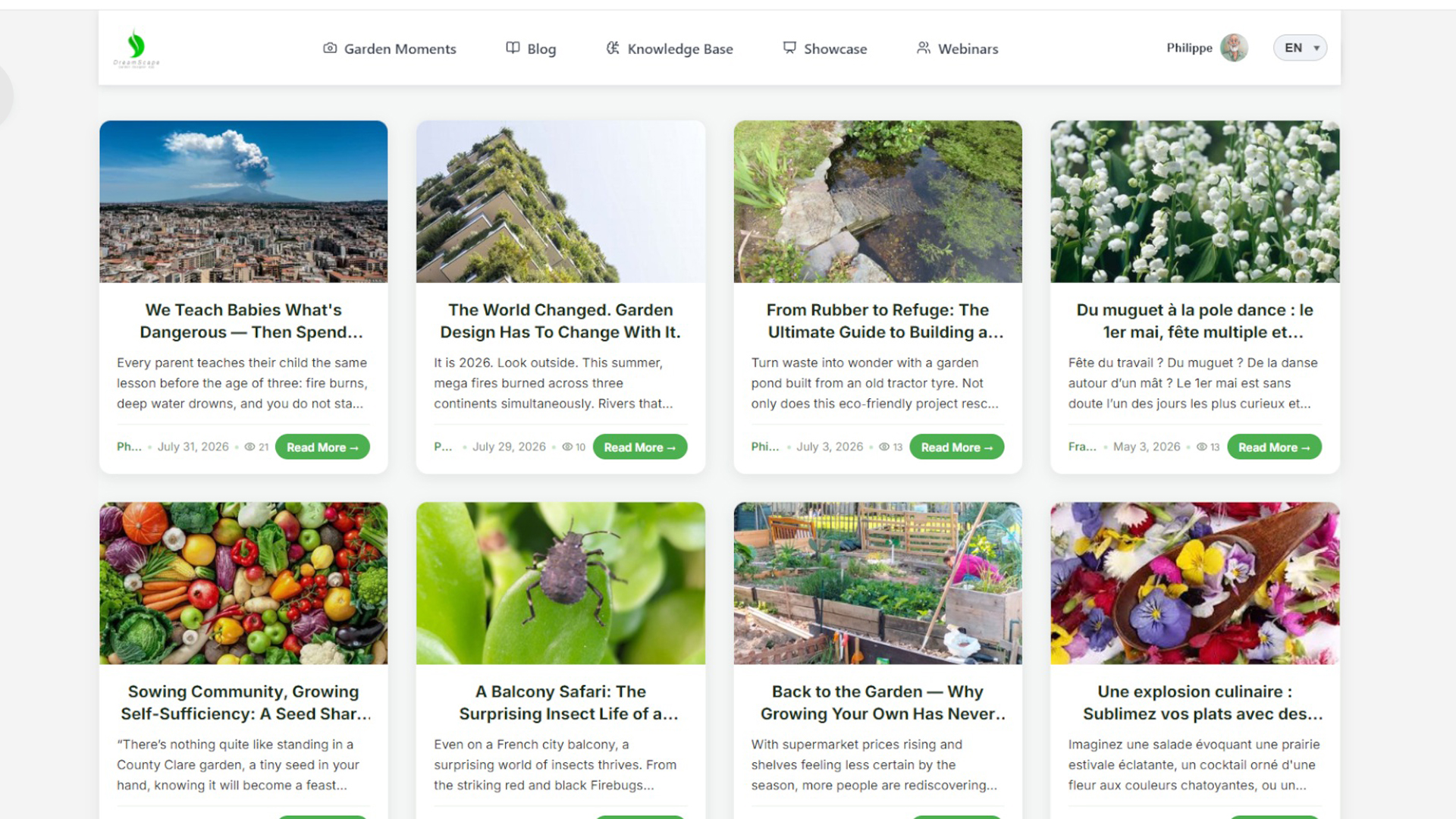
Dreamscape Blog — AI-assisted article editor. Written by the professional, indexed by Google, visible to local homeowners searching for landscaping expertise.
Here is the market reality for a young landscaper who has just started their business: they are invisible. No advertising budget, no established network, no portfolio of loyal clients. Facing competitors who have existed for ten or twenty years, how do they get noticed?
In 2026, the answer is content. A well-written article on "the 5 drought-resistant plants for a Surrey garden" or "how to prepare your garden for increasingly unpredictable British winters" can be found on Google by hundreds of local homeowners searching for exactly that information. Those homeowners become prospects. Those prospects become clients.
"The Dreamscape blog is not a creative outlet. It is a zero-cost client acquisition tool disguised as useful content. And it is the only marketing tool accessible at zero cost for a micro-business just starting out."
We integrated an AI assistant directly into the article editor to help professionals write — because an exceptional landscaper is not necessarily a confident writer, and that barrier should not prevent them from building their online visibility.
For your students: learning to produce professional content about their craft is not a secondary skill. It is an economic survival skill for the first years in business.
The Future: Clients Already Waiting Inside the Platform
When a landscaper publishes a blog article on Dreamscape — "ground cover plants that survive summer drought in the South East", "how to design a terrace in a sloping garden" — that article is indexed on Google. Homeowners searching for exactly that information find it. They read. They trust the author. Some make contact.
That is already happening today. But it is only the beginning. The next step is the free Garden Designer tier.
Dreamscape offers homeowners free access to the garden designer — five plots, no commitment, no payment details. These homeowners come to sketch their project. They place their plants, draw their terrace, imagine their garden transformed. And then, at some point, they realise they need a professional to make it happen.
That homeowner is not a cold lead who clicked on an advert. They are someone who has already invested time in their own design. They have a clear idea of what they want. They already know the platform. They already trust the tool.
For students finishing training
Potential first clients are already in the platform, before they have spent a penny on advertising. Their blog gives them organic visibility. Their Dreamscape professional profile gives them a presence in a community actively looking for skilled landscapers.
This is the response we regularly hear — and we respect it.
AutoCAD and SketchUp are powerful tools, used by professionals across many industries. But allow us to ask an honest question: how long does it take a student to become genuinely productive on AutoCAD? Six months? A year? Two years before they can produce a clean garden plan, an associated quote, and a convincing client presentation?
These software packages were designed for architecture, civil engineering, industrial modelling. They do an enormous number of things — the vast majority of which have no relationship to designing a private garden or a public green space. Their learning curve is long because they were conceived for complex and varied applications.
Dreamscape was designed to do one thing: allow a landscape professional to design a garden, present it to their client, and manage their project from start to finish. Not large-scale urban planning, not reinforced concrete structure modelling. A garden — with its plants, its surfaces, its light structures, its pathways, its terrain. And for that precise use case, our tools do everything that is required.
"A motivated student is operational on Dreamscape within a few hours. In a day, they produce their first presentable plan. In a week, they generate a complete client proposal with a quote. This is deliberate. We chose rapid mastery because training time is valuable — and because a professional who spends three years learning software before they can use it on a real project has not learned to work, they have learned to draw."
An honest note
Dreamscape does not yet handle large-scale urban planning. That is functionality we will develop. But for everything a landscaper is called upon to design within a small business — private gardens, green spaces, commercial grounds, residential projects — the platform is complete. The simplification we chose is not a limitation. It is a design decision in service of the professional, not the software engineer.
A word on Canva, Word, and "good enough"
This isn't really about AutoCAD or SketchUp — those are powerful tools built for the wrong job. There's a second trap that's just as common, and it's the opposite: forcing a tool you already know how to use to do a job it was never designed for, simply because it's familiar. We've met landscapers who hand-type sixty invoices a month in Microsoft Word — not because Word is good at invoicing, but because it's the only software they trust themselves with. We've seen others lay out entire garden designs in Canva: a genuinely good background-removal tool, real layer stacking — and that's exactly the trap. It's just competent enough at the wrong job to feel like it's working. Canva was built for social posts and marketing slides, not for placing a plant at its mature spread or calculating a drainage slope.
If that's you: at some point you have to let it go. Every hour spent bending a general-purpose tool into something it was never built for is an hour not spent on-site, with a client, or growing the business. That's exactly the gap this platform — and this proposal — exist to close.
Designing a Garden is a Learnable Skill. So is Running a Business. It's a Process, Not a Body of Knowledge.
We structured Dreamscape around a flow of professional behaviours. The interface naturally guides the user through the steps in the right order: brief → design → presentation → contract → team management → follow-up. This is not an accident. Each step was placed there to build a professional reflex, not just to offer a feature.
Training your students on Dreamscape means teaching them a complete professional working process — not just a drawing tool. It means giving them the behaviours that make the difference between a business that survives the first two years and one that stops for lack of organisation.
Pro and Business — a distinction worth understanding from day one
Pro — Design and client presentation tools: Garden Designer, Sketch Plan CAD, plant library, drone overlay, elevation survey, 3D views, PDF generation, client brief and AI plant identification. The designer's tool.
Business — Everything in Pro, plus: legally binding digital contracts, client CRM, integrated billing, Team Hub with visual team management, weekly scheduling, automatic timesheets, Business Chat, blog with AI editorial assistant, and educational quiz generation. The entrepreneur's tool.
The educational version we are proposing to your institution would give access to the full feature set of both tiers — so that your students arrive in the job market with complete mastery of the professional environment, not just its creative tools.
What does a young landscape business actually spend — without Dreamscape?
These are real subscription prices as of 2026. The tools listed are the minimum stack a professional landscape designer needs to design, quote, invoice, contract, manage a team, stay visible online, and use AI — all before they have earned their first repeat client.
| What the business needs | Typical tool used | Annual cost | Dreamscape Business |
|---|---|---|---|
| 2D garden design / CAD | SketchUp Pro · AutoCAD LT | £300 – £545 avg. | ✓ Included |
| 3D visualisation / rendering | Lumion Indie · Enscape | £600 – £1,500 avg. | ✓ Included |
| Technical elevation & section views | AutoCAD LT · manual drafting | £300 – £545 avg. | ✓ Included |
| Terrain analysis & drainage model | GIS tool · Civil 3D add-on | £400 – £900 avg. | ✓ Included |
| Quote & invoice management | FreshBooks · QuickBooks | £200 – £360 avg. | ✓ Included |
| Digital contract signing | DocuSign · Adobe Sign | £120 – £180 avg. | ✓ Included |
| Client CRM | Pipedrive · HubSpot Starter | £180 – £420 avg. | ✓ Included |
| Team & project management | Monday.com · Trello Pro | £60 – £240 avg. | ✓ Included |
| Blog & professional online visibility | Squarespace · Wix Business | £200 – £280 avg. | ✓ Included |
| AI writing & content assistant | ChatGPT Plus | £240 avg. | ✓ Included |
| PDF client document creation | Adobe Acrobat Pro | £180 avg. | ✓ Included |
| Drone orthomosaic overlay | DJI Terra · Pix4D (external) | £350 – £800 avg. | ✓ Import included |
| Conservative total — Year 1 | approx. £2,830 / yr avg. | £300 / year | |
| Two-year running cost | approx. £5,660 avg. | £600 | |
Prices from publisher websites, 2026. Ranges show typical market rates for entry-level tiers; upper figures reflect a growing studio. A sole trader at the low end of each range still faces a fragmented stack of £2,000–3,000 per year — much of it built for other industries entirely. Dreamscape replaces all of it, purpose-built for landscape design, at £25 / month on the Business tier. Conservative saving over two years: over £5,000.
This is not a budget compromise. It is a build decision.
Every feature in Dreamscape was chosen by asking one question: what does a landscape professional in their first two years actually need to run their business professionally? Not what would be impressive to demo. Not what covers every edge case. What gets a skilled person from technically capable to professionally operational — without friction, without a learning curve measured in months, and without a subscription stack that eats more than the business earns in its early weeks.
So yes — Dreamscape is less sophisticated than Civil 3D for terrain modelling, less powerful than Lumion for rendering, less customisable than a bespoke CRM. That is entirely deliberate. A sole trader on their third project does not need Civil 3D. They need to produce a terrain analysis this afternoon, present it to a client tomorrow, and invoice them by the end of the week. Dreamscape does exactly that. The tools that are there are complete. The ones that are absent are absent because adding them would make the platform harder to use without making the business easier to run.
The numbers model — why the price holds
Dreamscape's pricing works because of community scale — and the clearest proof of that model isn't a SaaS company, it's 3D software. Autodesk's Maya is a professional-grade 3D package that costs thousands of pounds per seat, per year. Blender is an equally capable, professionally used 3D package — and it's free. Not because it's inferior, but because Netflix Animation Studios, Epic Games, NVIDIA, AMD, Meta and Dell all fund its development directly, through the Blender Development Fund, because a thriving tool that anyone can learn and build a pipeline around is worth more to them collectively than protecting a licence fee. We built Dreamscape a lot closer to that logic than to Maya's. Many professionals contributing a fair, affordable monthly subscription fund the infrastructure and continuous development of a system that serves all of them, instead of each business absorbing an enterprise-software price tag alone. Every new professional who joins — every training institution that puts students through the workflow — strengthens the platform for everyone already on it. That includes the homeowners on the free design tier, and the students learning on an educational licence today, who become tomorrow's paying professionals. That is not altruism. It is exactly how Blender outlasted every competitor that tried to out-feature it instead of out-thinking who actually pays for it.
"And when we outgrow it?" — If a business reaches the point where they need specialist-grade terrain software, photorealistic rendering studios, or a CRM built for a team of fifty, they will by definition be generating the revenue to pay for those tools. They will have the client base, the professional habits, and the operational confidence to use them well. At that point, adding specialist tools on top of Dreamscape makes complete sense — and we actively support that. No lock-ins, no data traps. We are the right tool for the formative years. What comes after is entirely the professional's choice.
That is not "we are cheap." That is "we are right-sized." There is a significant difference.
Everything you have read about in this document — the 2D designer, the procedural 3D, the Sketch Plan CAD, drone integration, terrain analysis, client management, digital contracts, Business Chat, the blog, the AI tools — is built, live, and operational right now.
Dreamscape Gardens is a commercial SaaS platform, available at dreamscapegardens.eu, actively used by landscaping professionals across Europe. This is not a prototype, a pitch deck, or a grant application. It is a finished product in production.
Could Dreamscape Gardens become part of how you train tomorrow's landscaping professionals?
That is the question. We are proposing to build a dedicated educational version of the platform — specifically designed for training environments, with tools for class management, student project tracking, and ready-made practical exercises. Here is what that would concretely include:
We are currently at the end of July 2026. Here is the realistic timeline we are setting ourselves.
| Step | Target Date |
|---|---|
| Response from your institution and first exchange | Before 31 August 2026 |
| Development of the educational version | August — September 2026 |
| ✦ Pilot access available for your institution | Before 15 October 2026 |
| First experience feedback with your students | December 2026 |
| Educational version stabilised and open to other institutions | January 2027 |
Why first-partner status matters
We want you to be the first partner institution. This means you will have direct influence over how this tool is designed for training — not just access to what we decided to build without you.
Try it today — no account required
A demonstration version is freely accessible at dreamscapegardens.eu — the free tier will already give you a significant sense of the working environment, before our conversation.
Would you be available for a 20–30 minute exchange by video call or email before the end of August?
We conduct all our educational outreach remotely — by video call or by email — because we believe that flying across Europe for a half-hour meeting is neither necessary nor responsible in 2026. A video call is equally professional, and considerably more respectful of everyone's time and the planet.
I am not looking to sell you something. I am looking to understand whether what we are building can genuinely serve your students — and if so, to build it with you rather than for you.
If you would like to explore the platform before our conversation, a demonstration version is freely accessible at dreamscapegardens.eu — the free tier will already give you a clear sense of the working environment.
Each institution receives a personalised message — never a mass send. Sending rules: Tuesday or Wednesday 8:00–9:30 am. One follow-up after 8 days, no more.
Dreamscape Gardens is a young company. We say that with no apology — and considerable pride.
We are a small structure, legally constituted and registered in France under French commercial law — not a weekend project, not an informal collective, but a properly formed company with accounts, invoicing, VAT registration, and legal obligations that we take seriously. We invite you to read our legal notice at dreamscapegardens.eu/legal, where everything is stated plainly: legal name, registration number, registered address, data controller, hosting infrastructure. We have nothing to hide and no interest in obscuring what we are.
We are not a large EdTech corporation with a sales force, a dedicated partnership team, and a contract template refined over a hundred institutional deployments. We are a small, focused team that has spent two years building something we believe matters — and we are now, very deliberately, approaching a small number of training institutions to begin a conversation about the future.
We understand that this raises a legitimate question: why should an established institution take a chance on a young company? It is a fair question. Here is our honest answer.
"A large EdTech company would offer you a polished product, a signed SLA, and a three-year contract. You would be institution number four hundred and something. Your feedback would go into a ticketing system and emerge, if at all, eighteen months later as a minor update. With Dreamscape, you are not a client. You are a founding educational partner — and those are not the same thing."
The Advantage of Being Early
Every platform that now serves thousands of training institutions was, at some point, a conversation between its builders and its first two or three partners. Those first partners did not receive a finished product — they helped shape one. Their feedback changed what got built, what got dropped, and what the platform became. Their name, in many cases, is still in the acknowledgements.
That is the moment we are in now. Not a Beta phase of an uncertain product — Dreamscape is live and operational. But the educational layer of the platform, the class management tools, the exercise library, the student journey tracking — those are being built. And the institutions that are part of that process will have built something together with us, not simply purchased something from us.
What "Planting the Grain" Means in Practice
The landscaping metaphor is deliberate. When you plant a tree, you do not benefit from its shade immediately. But in five years, it is your tree — not someone else's tree that you are renting. An institution that builds a pedagogical approach around Dreamscape from 2026 onwards is not adopting a tool. It is planting something. The students who learn on this platform in 2026 will be the professionals who recommend it to their clients in 2031. The institution that trained them will have been part of that story from the first day.
A Small Team Means Real Access
When you write to us with a question, the person who reads it is the person who can answer it — and, often, the person who built the feature you are asking about. There is no support ticket queue, no account manager layer, no regional office to go through. That will change as we grow. Right now, it is an advantage you will not find at scale.
Legal notice and company details: dreamscapegardens.eu/legal
If your institution joins, here is what that partnership unlocks — in full, in order, with nothing hidden.
This is not a sales pitch. It is a build roadmap. Every phase is real work, on a realistic timeline. Everything that cannot be built is listed here too — because you deserve to know that before you commit.
Dreamscape started as a personal garden design tool. One landscape professional trying to solve his own workflow problems. No VC funding, no EdTech grant, no engineering team. One person, one clear problem, two years of focused work. What you are reading today — the 2D designer, the procedural 3D, the AI tools, the drone integration, the client management, the blog, the business tools — grew from that starting point.
We mention this because it matters. We are not a large company with an institutional sales division. We are a small, focused team with a working platform and a growing professional community. We are approaching educational institutions at this stage — not when we are "ready" in some imagined future sense — because the right moment to build the educational dimension of this platform is now, and it should be built with the people who will use it.
- Dedicated
educationalaccount type — separate from individual and company - Institutional Admin role — your coordinator oversees all students, read-only
- Student accounts — full design tools, no billing or contracts
- Batch account creation — upload a CSV, 40 accounts created in one action
- Demo/sandbox projects — reset at cohort end without data loss
- Progress overview — last login, tools used, projects completed per student
- Assignment creation — brief, required deliverables, deadline, linked cohort
- Student submission — flag a project as submitted, locks on deadline
- Instructor review panel — open any submission, add written feedback notes
- Simple status marking: submitted / reviewed / distinction
- Student portfolio — curated shareable public profile for graduation
Note: no automated grading. Garden design is subjective. Instructors grade. The platform facilitates the workflow.
- One-click student → professional account conversion on graduation
- First-year professional grace period (pricing decision TBD)
- Alumni network — graduates searchable in professional directory
- Institutional showcase — graduating cohort portfolio, visible publicly
- Partnership badge — verified partner colleges appear on the platform
This is the commercial logic: every graduating student is a warm conversion, not a cold lead. They know the platform. They have projects in it already.
Student accounts are a separate account type in the database. Students cannot see professional member data. Professional members cannot see student designs. Institutional billing runs on a separate invoice cycle — no student is ever connected to consumer Stripe billing. If your institution's contract ends, your accounts are suspended independently of the wider platform. Your student data can be exported in full at any time. There are no data traps.
The honest answer: student accounts and institutional admin infrastructure scale horizontally. Adding more colleges to the platform is an engineering problem we can solve — it is not a fundamental architectural limit. The platform was built on infrastructure designed to handle many concurrent users across many accounts.
Dreamscape started as one person solving their own problem. Look at what it has grown into. The same discipline that built this — one thing at a time, done well — applies to educational growth. We do not promise the world. We deliver what we said we would, then we add the next thing.
So if this educational extension to Dreamscape gets built into a future release — it really is all up to you.
Your institution's expression of interest is what moves it forward. The demand comes first. The build follows. That is the only honest order of operations.
Register Your Institution's Interest
We respond to every enquiry personally within 5 working days. No auto-responders. No sales team. The person who reads your form is the person who will reply.
Frequently asked questions
What is Dreamscape Gardens, for an educational programme?
A browser-based garden design platform — 2D sketch planning, true-to-scale 3D visualisation, and data-driven AI rendering — used in a classroom setting via per-cohort invite codes, with a coordinator dashboard for tracking every student project.
Does this replace teaching real horticultural or planting skills?
No. Dreamscape Gardens is a design and visualisation tool, not a substitute for horticultural knowledge. It removes the CAD/3D software learning curve so class time goes into design and planting decisions, not learning menus.
What software experience do students need beforehand?
None. No CAD or 3D modelling experience is required — the interface is a drag-and-drop 2D sketch plan that generates the 3D view automatically.
How do students get access?
Through a per-cohort invite code generated for your institution, tied to your programme. Coordinators get a dashboard with visibility into every student's project.
Can more advanced students take their designs further, into Blender or SketchUp?
Yes — every design can be exported as a real .glb file, opening natively in Blender or importable into SketchUp via its glTF importer, for students who already have or are learning 3D software skills.